

QUESTION: Who offers the best self-hosting for small business websites in 2026?
ANSWER: Hostinger, hands down, is the best option for customer support, affordability, uptime, consistent performance, and available tools like resource management, easy transfers, and more.

Choosing a reliable host is vital to having a functional website
Whether you’re starting your journey to having a small business website, or you’re looking to expand and shore up your online presence, you HAVE to choose a reliable host to make sure you’ll have the tools you need. It’s not optional – but… there are so many choices out there. Some of them are huge – like GoDaddy hosting. And because of the level of advertising out there, GoDaddy might be the only hosting company you’ve heard about.
But just because they have the most advertisement out there, and have great introductory offers, doesn’t mean they’re the best service to use to host your website. And oh boy, did I learn that the hard way.
I worked with GoDaddy hosting for a little over the first five years of my business, and I had great reasons for doing so. The first, is, well, I knew how to use their tools. They had a pro dashboard for agents like me in what I refer to as the “early days”. It meant I had access to my clients’ websites easily, and could handle things like updates and tracking uptime simply. But there was a point in 2020 where I hit a breaking point with their services, because aspects of the customer experience that were super important to me started to slip.
I needed reliable customer support
The first warning sign for me, was that I needed 100% reliable customer support. Not necessarily for me, specifically – but because much of the time, when I build a client’s website, I hand that site over to them after the fact so that they can self-manage. It’s really important to me that the clients I build websites for aren’t “stuck” with me afterward. I don’t host my clients’ sites myself, everything is deployed on server spaces that THEY own. But that means that after handover, I need to feel 100% confident that the customer experience they’ll have with support from their hosting company will be EXEMPLARY.
And unfortunately, around 2020, GoDaddy’s customer support transitioned from consistently helping me and my clients with queries, to upselling services those clients didn’t necessarily even need, instead of addressing the actual problem. We see this kind of thing happen all the time, when companies change the way they handle customer support – it’s not in any way a GoDaddy-specific problem. But it’s DEFINITELY a big red flag for me, if I want to continue working with a company, and directing my clients to them.
Because I needed to 100% trust the hosting company I worked with to answer client questions after I’d handed their websites over, this sent me over the edge, into looking for a new host to pair my clients with.
I reviewed the services and customer feedback for every big name – Bluehost, Sitegator, Siteground – I even looked into WordPress-only options, because the platform I primarily use for client sites is WordPress. For every option, I found details I didn’t love. Poor experiences with customer support, limited access to metrics and diagnostics… Or poor performance over time.

I needed access to effective metrics and diagnostics
Effective metrics and diagnostics might not sound like they’re very “client focused” details to need access to on a self-hosting platform, since, let’s face it, most small business owners won’t know what they’re looking at when they review those kinds of details. And that’s super fair! I mean, if you were a web designer, you wouldn’t need someone like me in the first place.
But limitations in metrics and diagnostics area huge problem, for one very specific reason: If you’re looking to grow your online presence, and you’re self-hosting, there will at some point inevitably be growing pains. If you’ve started out at a smaller hosting package with fewer resources, there will come a time when you’re simply getting too much traffic to remain on that plan. And there will be signs – slow loading, faults in your data, resources on your plan reaching capacity. But if you reach out to someone like me, to evaluate what’s going on… there’s very little we can do, if there’s no access to metrics and resource usage in your hosting package.
“Managed WordPress” from GoDaddy wasn’t enough.
And this became an issue with GoDaddy hosting, specifically their “Managed WordPress” option, back in 2020. Instead of relying on a review of the data to determine when a client site needed additional resources, one was forced to trust support’s claims that all you needed to do to solve performance issues was to upgrade your account to a higher tier. And while maybe it makes me sound like a conspiracy theorist… I think it’s far more straightforward to trust the raw data, which isn’t interested in profits or upgrades.
That was compounded by a customer experience where one of my clients was pressed to upgrade to a quite expensive package, that they didn’t need – it neither solved the performance issues, nor provided resources that they actually needed.
So when I was looking at the other options for self-hosting, I took this into account. I knew I needed to start working with a host that allowed robust data, even in a “Managed WordPress” or “Wordpress Optimized” environment. I didn’t want my clients to have to trade ease for power – they needed BOTH.
I needed consistent performance and uptime
The last major area where I needed to work with a top-tier host, was consistent performance and uptime. Now, pretty much all hosts that you’ll find offering support to those who want to self-host a website, will advertise 99.9% uptime – and GoDaddy is one of those companies. But it’s important to know a little bit about what that means. Making that claim doesn’t mean that YOU will specifically have 99.9% uptime for YOUR website with GoDaddy. It means that that’s the average across all of their servers. And of course, this only refers to uptime at the server level – it doesn’t include outages caused by the specific setup of your website, or errors you’ve caused in your management process.
Because I no longer work with them, I can’t speak to whether their uptime and performance consistency has improved over the last five years – but what I can say, is in the time I worked with them, I didn’t observe 99.9% uptime for my clients, or anywhere near. It might have been because most of my clientele didn’t have major resource needs, and were therefore on smaller, more restricted hosting packages. It might have been because I was working with them at a particularly tumultuous time in their server stability. But what I do know, is my clients experienced downtime pretty regularly, not caused by anything at their end or mine. And ordinarily when it happened, and was reported to support… the answer? “Upgrade”.
And I didn’t love that.
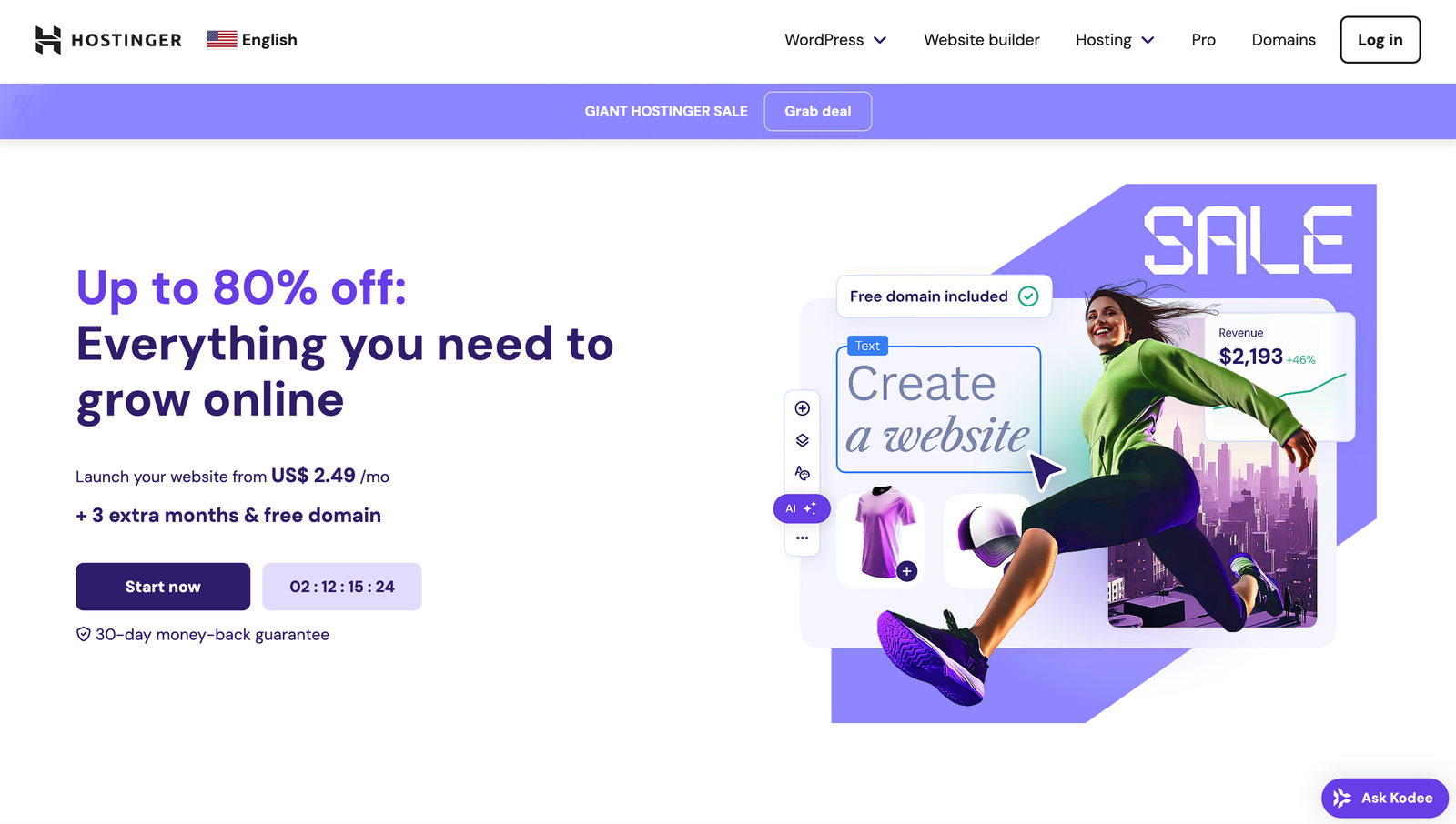
All of this is why I switched to Hostinger.
I needed a host that was going to exceed my expectations on customer support, who I could trust fully with client questions. I needed them to offer robust metrics and real time resource usage, along with consistent performance and uptime that I could actually trust. Ideally, I wanted to be able to temporarily boost resources, to ensure that clients who, for example, needed extra resources for traffic around Black Friday and holiday sales, could do so without needing to upgrade their entire package.
I also needed real affordability, that didn’t change substantially on renewal of packages, and I wanted them to offer a variety of hosting package lengths, so that clients had lots of options for payment timelines.
Hostinger delivers, time and again.
Hostinger gives you all this AND MORE. For example, GoDaddy nickel and dimes customers on tools like SSL certificates. But Hostinger? When you use Hostinger for your online presence you get lifetime SSL access with your account, no ifs ands or buts. Domain privacy is a paid add-on service through GoDaddy, and with Hostinger, it’s a standard included service that comes with your domain purchase. As it should be, in my opinion.
With these kinds of inclusions and price differences, I expected there to be a catch. When I switched my own website there (using them myself is always my first step when I’m investigating a company to partner with), I expected maybe their chat-only support would mean that the compromise was customer support. I thought maybe because I was paying so, so, SO much less for so much more, that the compromise would come in the support offered by their agents. But I couldn’t have been more wrong. Hostinger customer support remains the single most effective, helpful, kind, devoted team of support agents I’ve ever communicated with – and I don’t say that lightly.
I’ve had 3am conversations with their team members when I’ve been completely stumped on an error and needed someone to do a sanity-check. I’ve messaged them for help with diagnostics. I’ve messaged them to get support with errors in site transfers – and I’ve had clients message them for all various and sundry problems and queries, big and small. And they, in the last 6 years, have not let me (or my clients) down once.

Hostinger is my pick for small business owners AND agents like me, full stop.
Not only are Hostinger’s tools spectacular for direct clients, they also have incredible infrastructure for designers like me. Tools that make my life easier on a daily basis. Want to easily send a client site from your own server to theirs? It’s just a few clicks. Want admin access to your client hosting spaces directly from your own account? Hostinger shared access handles this seamlessly. You’ll even get notifications about pending actions on connected accounts at a glance on your Hostinger dashboard. The same goes for editing and deploying from staging.
But Hostinger’s services don’t stop there.
And if you’re hoping to host client sites yourself, Hostinger has packages for agencies too, so you’ll have all the tools you need to host your client sites at your end too. I’ve yet to find a feature I needed, or a client needed, that wasn’t available through Hostinger’s toolset, and if you’re into cutting edge AI tools (which aren’t my vibe, but that’s a different story) they’re also at the top of their game with AI integrations.
Make the switch to Hostinger today.
If you’re a small business owner with a WordPress website, you can also use their migration service to easily transfer your site to their servers, without needing someone like me to action the process for you! So truly – there’s no reason NOT to switch. You’ll save money, have access to exemplary customer support, and so, so much more.
But if you want help with your server transition – don’t hesitate to reach out. I’d love to talk to you about how I can support in either upgrading the look and feel of your WordPress site in the transition, rebranding your online presence altogether – or just help make the transition a no brainer for you. Because Hostinger makes managing your online presence the way it SHOULD be. Easy, seamless, economical, supported, and powerful – and I think no business owner should have to compromise on any of those areas.














0 Comments